
Starting an Asheville Resident Search
Asheville residents appear in different systems because the city, Buncombe County, and North Carolina keep different kinds of records. An address works best with the county tax and GIS tools. A current registration question belongs with the State Board of Elections. A court matter, estate, deed, permit, or old directory entry has its own custodian. The label on a search result matters. A recorded owner, voter result, directory entry, court party, and permit applicant are not interchangeable descriptions of where someone lives.
Use the record that fits the question first, then look for a second source that overlaps in time, address, household detail, or role. For an old name, a directory entry may supply a street and occupation, while a deed or obituary can test the connection. For a modern parcel, the GIS result and recorded deed should be read together. Asheville records can be partial, especially for older material, so a no-result should be described as a result from that particular system and date range.
- Write down the complete name, address, or year exactly as known, including initials and historic street spelling.
- Search Buncombe County Tax Lookup or BuncoMap when an address or parcel is known.
- Use North Carolina Voter Search for a current registration lead, then note the result date and county.
- Check the Register of Deeds name index for a recorded property role or prior instrument.
- For older household evidence, compare a directory scan, map, newspaper, cemetery, or archive record before drawing a conclusion.
Note: Keep the source URL and search date with each result, because a live record can be corrected, replaced, restricted, or removed.
Asheville Resident Record Custodians
Buncombe County handles the core land, court, tax, map, and election systems used in many Asheville searches. The City of Asheville keeps municipal files such as permits, planning material, cemetery information, boards, and City Clerk records. State agencies operate voter, vital, and statewide court services. Starting with the right office avoids a common dead end: the City’s public-record guidance itself sends real-estate and tax questions to the county, and court or divorce questions to the Clerk of Superior Court.
Buncombe Register of Deeds
205 College Street
Asheville, NC 28801
828-250-4300
Buncombe Land Records
182 College Street
Asheville, NC 28801
828-250-4970
Buncombe Board of Elections
35 Woodfin Street
Asheville, NC 28801
828-250-6262
The Register’s public search room is open Monday through Friday from 8:00 a.m. to 5:00 p.m. Its recording-submission window closes earlier, at 4:45 p.m. under the February 2026 notice. The Clerk of Superior Court at 60 Court Plaza is the court and estate counter. City records requests and municipal routing begin with the City of Asheville request service.
Tracing Asheville Parcels Through BuncoMap
BuncoMap turns a street address into a parcel research trail. The viewer supports PINN, street-name, owner-name, deed, and plat searches. Its layers include property, address, street centerline, ZIP Code, incorporated areas, zoning, precincts, and environmental context. A PINN is the county parcel identifier. It is useful for joining map and tax material, but it is not a street number and may change after a parcel split or recombination.
| Buncombe search route | Useful fields or result details |
|---|---|
| Tax Lookup | Address, owner, or PIN/PINN search in the live tax and GIS applications. |
| BuncoMap parcel search | PINN, street name, owner name, deed, or plat navigation. |
| Selected parcel | Situs and mailing address, acreage, assessment values, tax district, sales context, deed or plat references where displayed. |
| Map layers | Property, Address, Street Centerline, Incorporated Areas, ZIP Code, zoning, districts, and environmental layers. |
The Buncombe County Tax Lookup shown here is the county’s entry point for current assessment research.
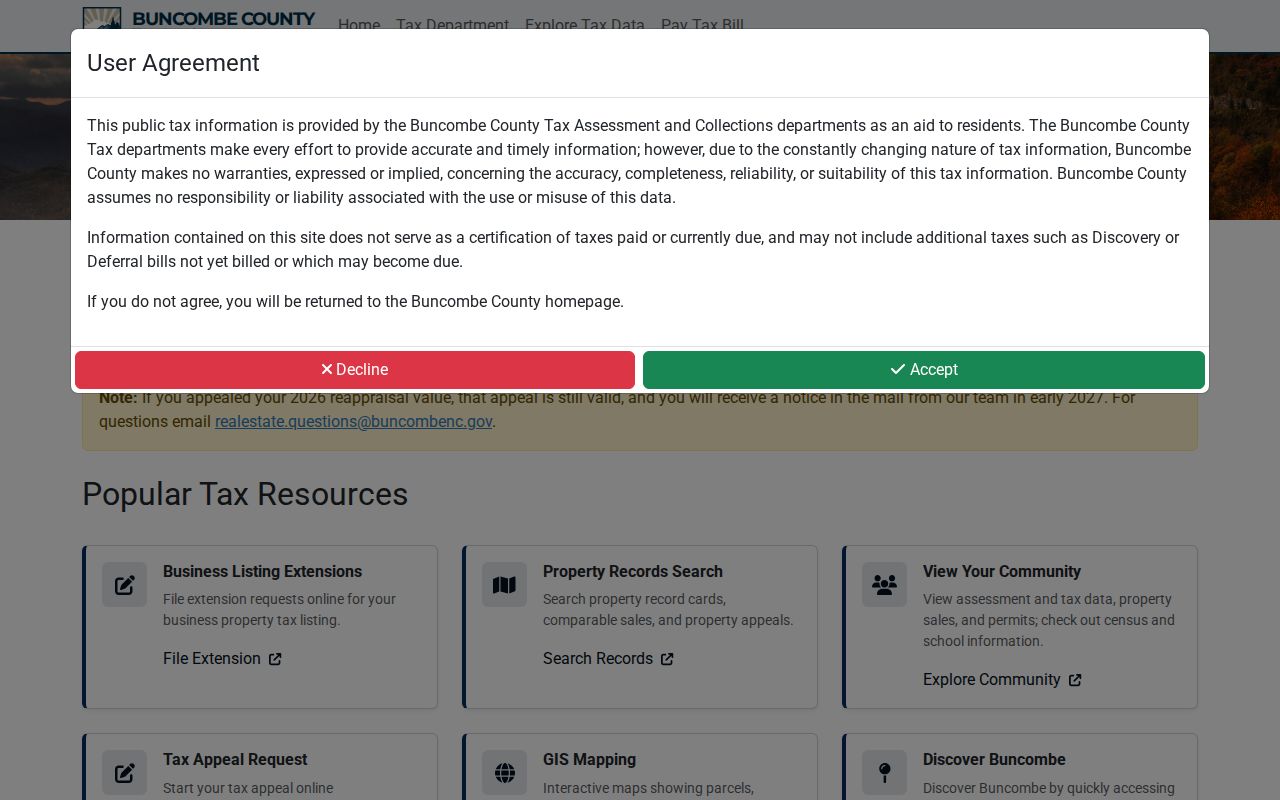
The tax and GIS results are a starting point for a parcel, not a declaration of current occupancy. The county cautions that GIS data supports taxation and public inquiry and is not survey-grade. Read a displayed tax mailing address separately from the situs, or physical, address.
When a parcel card points to a deed or plat, move from the map to the Buncombe Register of Deeds index and retain the instrument type, recording date, book, page, party roles, legal description, and prior-record reference. The office describes its real-estate collection as reaching as early as the 1700s. That collection statement is broader than the website coverage of any one index. An inspected Consolidated Real Property search showed a 1995 through 2026 range, so older deeds can require the public search room, staff help, or a State Archives route.
- Parcel
- A defined piece of land used in the assessment and mapping system.
- Situs address
- The physical address associated with a parcel, which can differ from where tax mail is sent.
- Plat
- A recorded map that depicts lot lines or a subdivision and helps explain splits or recombinations.
- Index
- A finding tool that points to a record. It is not always the record image itself.
Asheville Names in Voter Records
The North Carolina Voter Search is designed for a registration question, not a broad people profile. It requires a first and last name. A middle initial, year of birth, county, and status selection can narrow a common name. Its public result can show registration status, jurisdictions, polling-place information, sample-ballot information, absentee information, and voter history. County and statewide downloadable files are another access route for eligible public data, with the State Board’s definitions controlling the field meaning.
North Carolina law keeps date of birth, Social Security, driver-license or DMV, agency identity, and qualifying Address Confidentiality Program information out of public voter output. The record therefore works as one dated identity signal, not proof of every household member or a license to reconstruct a protected address. Buncombe’s Board of Elections can answer questions about its public file format or a particular registration at 35 Woodfin Street, by phone at 828-250-6262, or through elections@buncombenc.gov.
A current registration-data screen from the North Carolina State Board of Elections illustrates that the public files are updated on a recurring schedule.
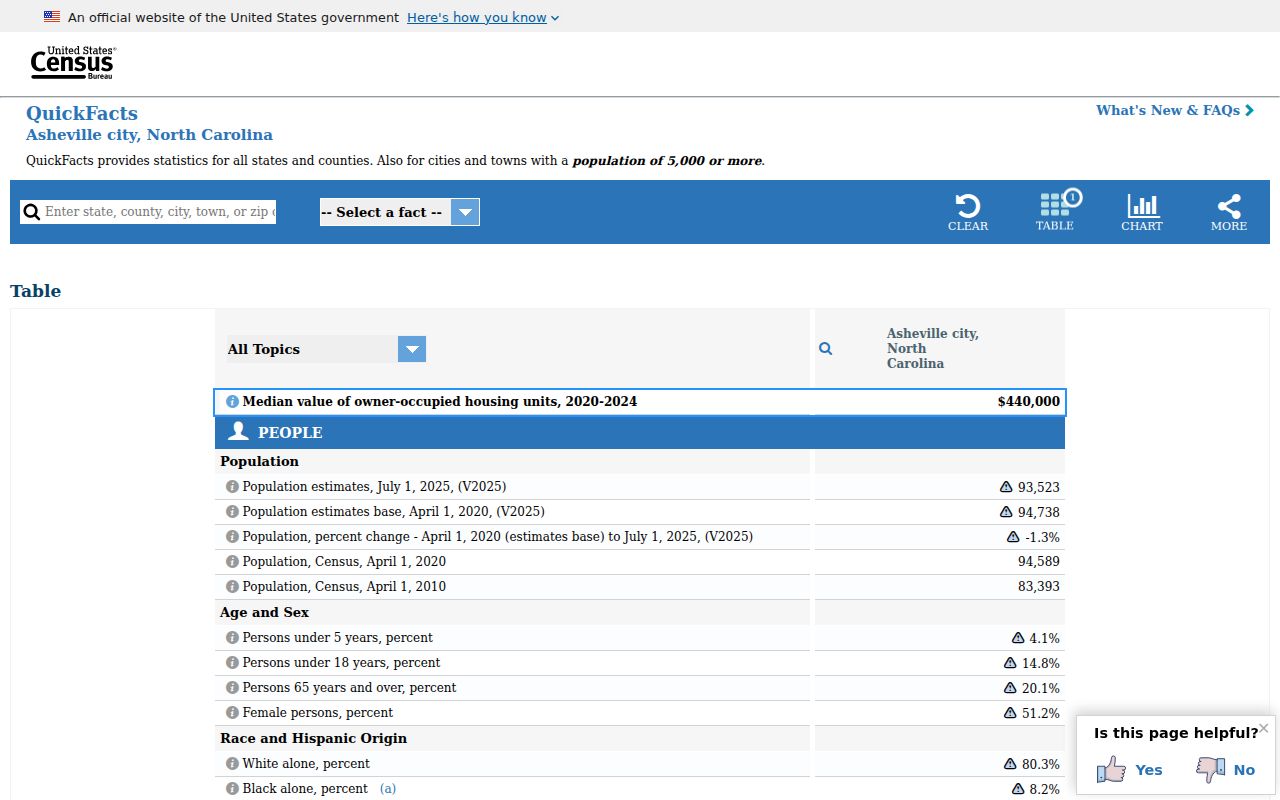
Census population context, like voter data, must be read with its geography and reference year. The Census QuickFacts profile reports a 2024 Asheville city estimate of 94,725, a city measure that does not describe all nearby postal or county residents.
Reading Asheville Court Results Carefully
A court name hit should be read as a docket result, not as a verdict about a person. The statewide North Carolina eCourts Portal offers Smart Search by party or case number. Advanced Search adds attorney or bar information, county or location, case type, and dates. Those filters help separate people with the same name. Case number, party role, filing date, event history, and disposition are more useful than a bare name match.
North Carolina reports that eCourts reached all 100 counties in October 2025, but statewide portal access did not turn every historic paper file into a public online file. Sealed, juvenile, expunged, and other restricted matters may be absent. For a non-certified courthouse search, use the Clerk’s public-access terminal. For a certified county criminal record check, the Clerk lists a $25 fee and its own request route. A certified copy, rather than a portal screen, is the appropriate route when an official legal record is required.
Current Asheville Resident Sources
There is no single current roll of every Asheville household. Each source has a narrower public purpose and a separate access path. Property records identify a parcel relationship. Voter records report registration information subject to legal protections. Recorded instruments show parties to a transaction. City files can provide an address-related event without establishing that an applicant or contractor lived there.
| Asheville source | What it can establish | Custodian | How to reach it |
|---|---|---|---|
| Tax and parcel record | Recorded owner, parcel, situs, mailing address, assessment context | Buncombe Land Records | Tax Lookup, GIS, counter, or request form |
| Recorded deed index | Grantor or grantee role, instrument date, book and page | Register of Deeds | Online index, search room, phone, or Archives route for older material |
| Voter registration | Public registration status, precinct, and jurisdictions | NCSBE and Buncombe Board | Name lookup or public-data files |
| Court docket | Party role, case number, filings, events, and disposition | eCourts and Buncombe Clerk | Portal, public terminal, division phone, or certified request |
| Permit or municipal file | Address, project, date, and named participant roles | City of Asheville | Permit lookup, Development Services, or records request |
When the goal is one named person rather than a place, compare the source labels and dates through the Asheville resident lookup workflow. A same-name match needs at least two independent details before it becomes a useful lead.
Asheville City Files by Address
The City of Asheville keeps municipal material apart from county land and court systems. Its permit lookup accepts Address or Parcel Information and can show current and completed development records. Permit type, application date, issued or completed date, project description, applicant, contractor, address or parcel, and inspection status can all be useful historical clues. They still describe a project role, not necessarily a resident.
Much pre-2019 permit material remains paper or has not been digitized. For that gap, contact Development Services at 161 South Charlotte Street or make a narrow City request identifying the address, permit type, department, date range, and preferred electronic format. Chapter 132 does not require the City to create a new list, but it can provide existing responsive records after redacting exempt material.
The City public-record request service provides the official routing for municipal requests.
The City’s routing is especially useful when a search crosses agencies: real-estate and tax issues go to Buncombe County, while court and divorce matters go to the Clerk and many police records use P2C or the Records Unit.
1865 Gaps in Asheville History
Buncombe County formed in 1791, and Asheville became the county seat soon after. Older searches face a major local limitation: the Buncombe courthouse was destroyed in January 1865. A missing early court, estate, or land item may require a different route, including surviving deed books, State Archives copies, predecessor-county material, newspapers, private papers, or later references. It does not prove the event or person never existed.
The Buncombe County historic-information page supplies the county’s official chronology and county-seat context.
For records outside an online index, ask the Register of Deeds, Clerk, or North Carolina State Archives which series and date range were searched. That narrower answer is more useful than an unsupported claim that no record exists.
Note: A record collection’s early start date does not establish one universal online cutoff for every book, index, or image series.
Asheville Historical Directory Evidence
Asheville city directories create a different kind of residents directory: a dated snapshot of how a publisher listed names, households, occupations, addresses, businesses, and telephone information. The first verified Asheville volume is the 1883-84 directory. DigitalNC also provides verified examples from 1890, 1906-07, 1930, 1932, 1940, 1948-49, 1950, 1959, 1960, and 1961. Pack Memorial Library’s North Carolina Room, UNC Asheville Special Collections, OBCGS, the State Archives, and DigitalNC provide the key library and archive channels.
The 1948-49 and 1960 volumes include Householders or Street Guide material that can work from an address back to a listed occupant. No separately titled complete Asheville criss-cross series was found in the official research. Directory evidence should be paired with a deed, census, obituary, cemetery, permit, or court source. The first 1883-84 volume itself warned that unnamed streets and off-street homes limited exact placement, so an old address may be a useful clue without being a modern map coordinate.
Browse DigitalNC Buncombe County city-directory results or use the fuller Asheville city directory collection treatment for a year-by-year trail.
Asheville ZIP Labels Need Checking
A mailing city and ZIP Code do not establish an Asheville city limit, voter precinct, neighborhood, or legal parcel boundary. The state tax crosswalk lists eleven Asheville and Buncombe-associated ZIP entries: 28801, 28802, 28803, 28804, 28805, 28806, 28810, and 28813 through 28816. The crosswalk is useful for tax and jurisdiction context, while USPS supplies delivery-address behavior.
Use the USPS ZIP Code lookup by address, city and state, or cities by ZIP before assigning a code to a particular address. BuncoMap’s ZIP Code and Incorporated Areas layers can then show the geographic context. The inspected sources did not verify a current USPS delivery classification for every code, especially 28802 and 28813 through 28816, so those labels should be checked live rather than assumed.
Official Asheville Sources Versus Compiled Listings
Official records and commercial compiled listings answer different questions. An official custodian can identify the record type, date, field limits, correction route, and legal access boundary. A compiled listing may combine older sources without making those distinctions. For family history, estate research, a seller verification, or a neighborhood question, the original county, city, state, library, or archive source gives a reader a clearer way to test the result.
| Official source | Compiled listing category |
|---|---|
| Shows a stated custodian, record purpose, and access channel. | May merge source dates and identities without an easy way to inspect each origin. |
| Offers a record-specific correction or certified-copy route. | Cannot correct the underlying deed, voter, court, or municipal record. |
| Preserves statutory redactions and confidentiality limits. | May not explain why a field is missing, dated, or mismatched. |
A captured view of North Carolina General Statutes Chapter 132 provides the state public-records framework.
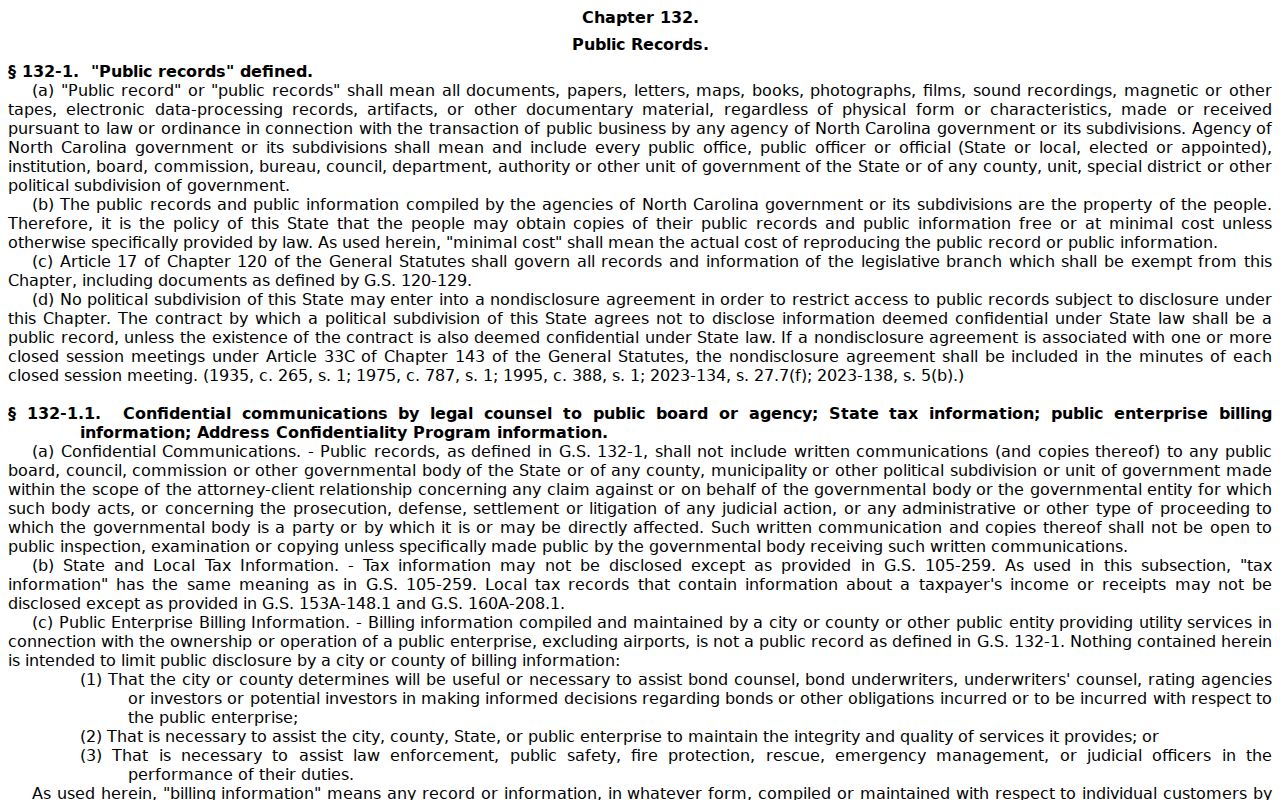
Chapter 132 supports inspection and copies of public records as promptly as possible, subject to record-specific exceptions. It does not require an agency to create a nonexistent record or disclose protected information.
Use Asheville Records With Care
North Carolina public access has limits. The Address Confidentiality Program can provide qualifying survivors and household members with a substitute address and mail forwarding. It does not erase every earlier deed or public record, and protected voter information cannot be used to reverse-engineer an address. Social Security numbers, financial account information, and other identifying numbers are also restricted in public records. A county mailing address or map pin should never be treated as a license to contact, track, or expose a person.
North Carolina’s Department of Justice also warns about deceptive recorded-deed notices and jury-duty calls that imitate officials and demand money. Use the Buncombe Register of Deeds or Buncombe Clerk contact published by the custodian to verify a notice or caller independently. The records trail is strongest when it ends with the office that actually keeps the record.