
Asheville City Directory Holdings
Asheville city directories survive through a mix of online scans and local shelves. The verified DigitalNC examples are an observed run, not proof that every year was printed, kept, or digitized. Start with the year nearest the event being studied, then compare nearby volumes. Pack Memorial Library's North Carolina Room is the principal local venue identified in the research, while UNC Asheville, the Old Buncombe County Genealogical Society, and the State Archives add maps, family material, county records, and newspapers that help test a listing.
| Collection | Years | Where Held | Access |
|---|---|---|---|
| Verified Asheville and Buncombe directory scans | 1883-84, 1890, 1906-07, 1930, 1932, 1940, 1948-49, 1950, 1959, 1960, 1961 | DigitalNC | Free record metadata and page-image or PDF access |
| North Carolina Room local-history material | Individual volumes and microfiche should be confirmed in the catalog | Pack Memorial Library | Local research room, staff contact, library resources |
| Maps and periodicals that support directory clues | Historic boundary, map, and Sanborn holdings | UNC Asheville Special Collections | Collection access and local research inquiry |
| Family and local genealogy material | Varies by collection | Old Buncombe County Genealogical Society | Consult the society for its indexes and access terms |
| County records and historic newspaper holdings | Series-specific coverage | North Carolina State Archives | Archives guides, finding aids, and research access |
The Pack resources page links city directories, a house-history guide, DigitalNC and library research databases. The county genealogy page also identifies the North Carolina Collection at Pack, 67 Haywood Street, for photographs, documents, maps, oral histories, microfiche newspapers, and related Western North Carolina material. For a visit, the house-history guide lists the NC Room on the lower level and advises confirming research hours before travel.
Note: A catalog gap or an absent scan means only that the specific holding or image needs further checking, not that no directory existed.
Asheville Directory Years in Print
The publishing trail changes over time. The 1883-84 volume names J.P. Davison and Baughman Brothers. Henry W. Fulenwider and Walker, Evans & Cogswell appear on the 1890 volume. Later verified examples include a Miller and Commercial Service Co. directory for 1930, a 1932 R.L. Polk and The Directory Company volume, Hill Directory Co. material, and Piedmont Directory Co. material. These publisher changes matter because a volume's departments and coverage can change with them.
- 1883-84: the first verified Western North Carolina directory in the reviewed material, with citizen and business listings.
- 1890 and 1906-07: a general directory and street or avenue guidance become especially useful for names, addresses, and printed abbreviations.
- 1930 through 1950: verified examples include 1930, 1932, 1940, 1948-49, and 1950, with alphabetical and street-focused material.
- 1959 through 1961: Hill volumes show multiple departments, including householders or street, business, and telephone-oriented sections.
The 1960 directory explicitly names places such as Biltmore Forest, Oakley, Kenilworth, Malvern Hills, Morningside, Redwood Forest, and Woodfin. That is the volume's own coverage language, not a present-day boundary map. The 1906-07, 1948-49, 1950, and 1960 scans also reach beyond a narrow central-city reading, so each volume's introduction should govern its geography.
Reading Asheville City Directory Entries
An Asheville city directory entry is compact, but its details should be copied exactly before they are interpreted. The alphabetical portion can connect a listed person or household with an address and an occupation. A later street guide can test who was printed at a particular number. A mark for a spouse, widowhood, boarding, residence, telephone, business, or a reported ownership or household status is a publication convention. It is not a legal finding about family status, occupancy, or title.
| Printed name | Keep initials, spelling, honorifics, and punctuation as printed, since OCR and later indexes can alter them. |
|---|---|
| Address | Copy the number, street form, direction, and any apartment or boarding language before comparing a map. |
| Occupation line | Record the work description or affiliation as a period clue, not as a current fact. |
| Household notation | Preserve spouse, widow, residence, boarding, telephone, and reported ownership or household marks exactly as the volume prints them. |
| Section and page | Note whether the clue came from the alphabetical list, street guide, householders section, or another department, plus the scan page. |
- Householder index
- An address-oriented part of a directory that can identify the household or business printed at a number.
- Criss-cross directory
- A separately titled reverse directory would sort listings by address; no complete separate Asheville series was located in the inspected official sources.
- Abbreviation key
- The volume's own explanation for short forms such as “res” or “bds”; photograph or transcribe it before interpreting an entry.
- Street guide
- A street or avenue section that may list numbered streets, intersections, householders, telephone details, or businesses.
The 1890 scan supplies an abbreviation key and boarding language. The 1948-49 scan can include a wife's name, widow notation, occupation, householders or street-guide material, telephone conventions, classified material, and institutional sections. Those features make the source richer than a name list, yet each result remains directory evidence that needs another dated record.
Asheville Householders by Street
No separately titled, complete Asheville reverse or criss-cross directory run was found in the official sources inspected. The practical substitute is already inside several verified volumes. Look for labels such as Householders, Street Guide, Street and Avenue Guide, and Numerical Telephone. Begin with a street and number there, then return to the alphabetical section for the listed person's spelling, address form, and other printed details.
The 1948-49 and 1960 scans contain householders or street-guide sections, while earlier books can include street and avenue guides. This pairing is useful when an address is the starting point, but it does not show a current household and does not prove ownership. For current address-keyed public records, use the separate Asheville street directory resource rather than treating a historical listing as a present result.
Note: Keep the alphabetical finding and the street-guide finding as two dated observations, even when they appear to describe the same household.
Asheville City Directory Access Paths
Digital access is the quick way to inspect a page image, but it is not the only route. The 1883-84 DigitalNC record provides the scan and its metadata. Pack's special-collections resources point researchers to directories, house-history material, DigitalNC and library databases; its archivist contact is packnc@buncombenc.gov. The house-history guide lists research hours, a phone number, and a work-backward method, while cautioning visitors to confirm current hours.
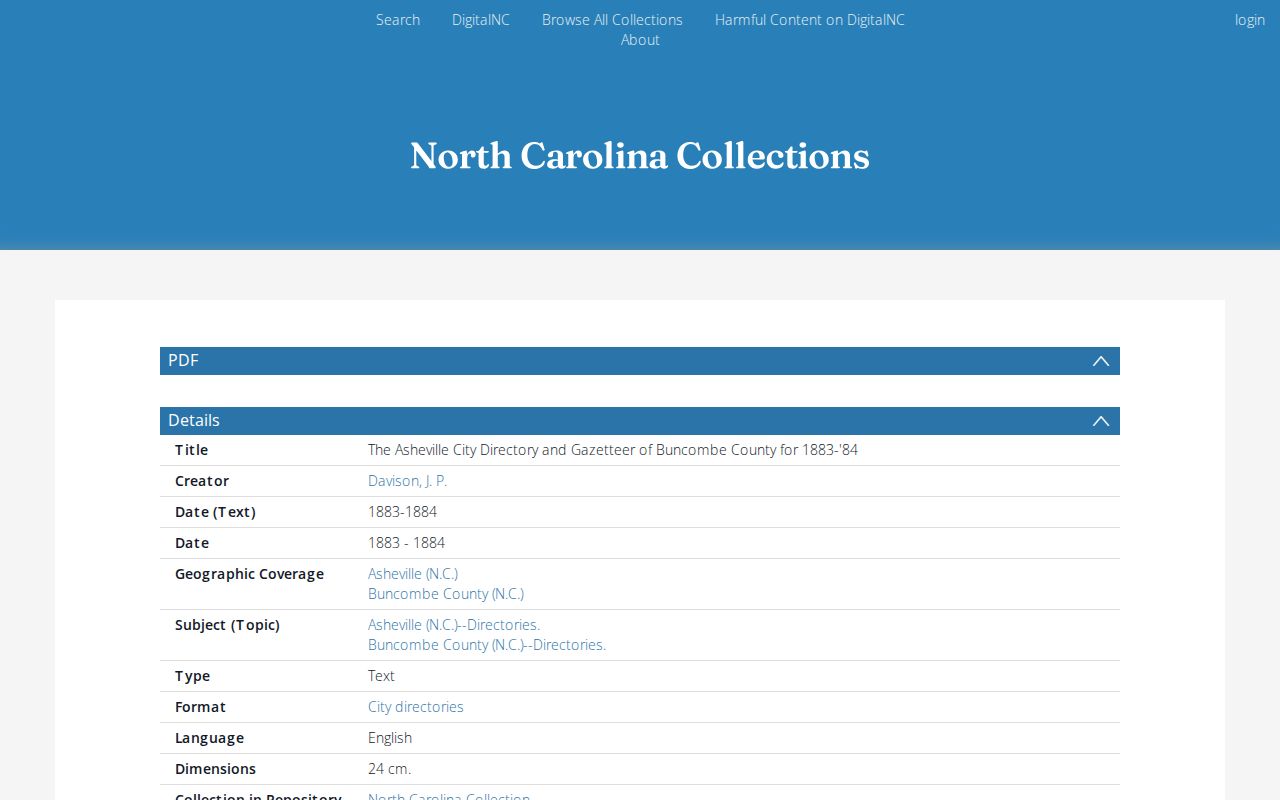
The DigitalNC image is a reminder to read the original page rather than an OCR snippet. It also leads directly to an unusually useful limitation printed in the early volume: unnamed streets and homes not located on streets could make exact placement difficult.
For local alternatives, the Pack NC Room is suitable for directories, maps, microfiche newspapers, and house-history materials. UNC Asheville adds special-collections material, and OBCGS offers local genealogy and family indexes. For county-record categories and newspaper run guides, use the State Archives. These access paths complement one another when an online scan has a missing page, weak OCR, or an unresolved address.
Asheville Directory Addresses on Maps
The first verified 1883-84 directory openly warns that unnamed streets and homes away from streets could defeat exact placement. Preserve the printed street, occupation, and boarding language, then compare the street guide with a map edition before attempting a modern parcel match. Asheville's reviewed sources did not establish a single historical citywide renumbering or renaming date. An old number should never be silently converted to a current one.
UNC Asheville's maps, books, and periodicals holdings include Asheville boundary changes from 1797 to 1917, annexations from 1997 to 2004, historic plats, Sanborn material, and other map resources. Those holdings can explain why a directory's geographic language differs from a current map.
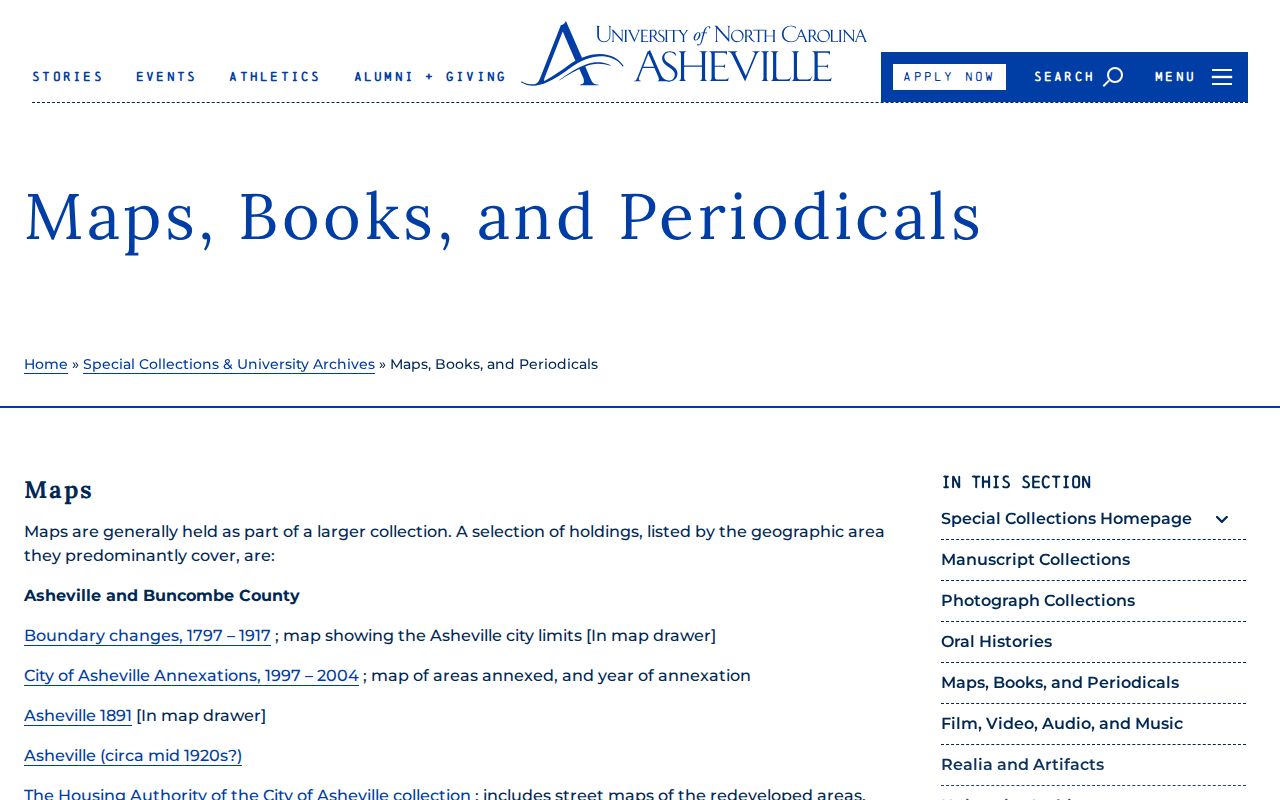
Map evidence can clarify a street form or show the physical setting of a listing. It does not turn a directory address into proof of legal title or a present residence.
Trace Asheville City Directory Households
A household trail works best when it moves in small, dated steps. Start with a full name plus a year or address. Copy the exact printed form, then compare adjacent directory years. A changed street, a move from boarding language to a residence, a spouse change, a widow notation, or a changed occupation can distinguish people with similar names. None of those clues should be treated as a final identity match by itself.
- Locate the name in the closest verified Asheville directory year and record the section and scan page.
- Read the alphabetical entry and the matching householders or street-guide material when the volume supplies both.
- Check adjacent years for the same spelling, initials, address form, and household notation.
- Pair a directory period with the appropriate federal census release, keeping the census household and enumeration context separate from the directory entry.
- Test the result against a deed, obituary, cemetery record, permit, court record, or newspaper notice that fits the same period.
Federal census records are snapshots, not continuous address registers. The 1950 census is publicly released, while the 1960 census is not due for release until 2032 under the general 72-year rule described by the National Archives. A directory can bridge time between census years, but a missing listing can reflect a move, omission, spelling variation, or the book's own coverage rather than a definitive absence.
Check Asheville Directory Evidence Twice
A directory result becomes stronger when another local source supports the same person, place, and time. For property questions, inspect the recorded deed and legal description through the Buncombe Register of Deeds. For a death or family clue, Riverside Cemetery research may supply a name, burial date, inscription, or marker photograph, while the newspaper guide identifies historical Asheville newspaper holdings. City permits may add a dated address reference, but a permit contact is not automatically an occupant.
When a historical directory match needs a present-day record check, a separate Asheville resident lookup can help keep name, date, and source roles distinct. Do not merge a directory address, tax mailing address, legal description, and cemetery location into one undated claim. Those are different facts, often held by different custodians.
Use a second record. Directory entries are useful for family history and local research, but they are not proof of title, a legal relationship, or a person's current location.
Buncombe's 1865 Records Break
January 1865 matters to Asheville directory research because the Buncombe courthouse was destroyed during the Civil War period. A later family reference or deed citation may point to an early court, estate, or land item whose original volume did not survive in one complete courthouse series. The safer conclusion after a negative search is that the item was not found in the surviving or indexed series inspected.
Use the State Archives county records box lists, surviving deed books, newspapers, private papers, predecessor-county research where appropriate, and later references to widen the search. The courthouse loss is a records-access fact, not a reason to fill a gap with an unsupported address or family connection.
Note: For a record before 1791, confirm whether a predecessor county rather than Buncombe held the relevant jurisdiction at that time.